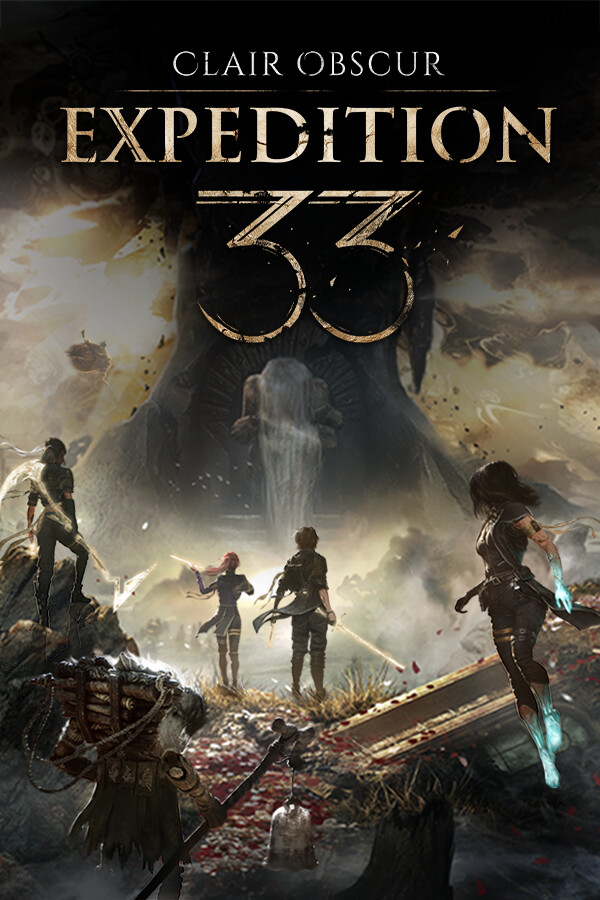
Painting Fate in Brushstrokes of Brilliance
Every so often a game arrives that feels like it fell from another dimension — one where art and mechanics conspire in perfect harmony to create something that lingers in your thoughts long after the credits roll. Clair Obscur: Expedition 33 is that game. Developed by the French studio Sandfall Interactive in their debut outing, this turn-based RPG swept The Game Awards 2025 with nine wins, including Game of the Year, and we struggle to think of a more deserving recipient. From its first haunting frame to its devastating final act, Expedition 33 is a masterclass in how to tell a story through every element of game design — from combat animations to environmental storytelling to a score that could make stone weep. It is, without reservation, one of the finest RPGs we have played in the last decade.
Overview
Clair Obscur: Expedition 33 drops you into a world ruled by the Paintress, an enigmatic and all-powerful being who each year paints a number on a monolith. Every person whose age matches that number simply ceases to exist, erased from reality overnight. The number is now 33, and a group of volunteers — the expedition — sets out across the hauntingly beautiful land of Lumière to find and destroy the Paintress before the count reaches zero. It is a premise that drips with existential dread, and Sandfall Interactive exploits it brilliantly. Published by Kepler Interactive and released on April 24, 2025, for PS5, Xbox Series X|S, and PC, the game was also available day one on Xbox Game Pass — a decision that helped it reach an enormous audience almost immediately. The studio drew from French Belle Époque architecture, Impressionist painting, and surrealist art to create something that looks unlike anything else in the genre.
Gameplay and Mechanics
At its core, Expedition 33 is a turn-based RPG with a twist that keeps every single encounter engaging: active timing. Every attack, every block, every special ability requires precise input from the player. Landing a sword strike isn't a matter of selecting "Attack" and watching an animation play out. You commit to the swing, and a timing window appears — nail it and the damage multiplies, miss it and you deal a fraction of the potential output. The same principle applies to defense: when an enemy winds up a devastating blow, you can parry it with frame-perfect timing or dodge it with a well-timed evasion. This turns what could have been a passive menu-driven system into something that demands your full attention on every single turn.
The depth extends further through a robust class system. Each of your party members can equip Luminas — ability modules that define their combat role. Gustave, the expedition's stoic swordsman, can be built as a frontline tank who absorbs damage and counters with devastating ripostes, or retooled into a swift dual-wielding attacker who sacrifices defense for raw DPS. Maelle, the group's marksman, can specialize in single-target sniping with enormous critical hits or spread her damage across the field with explosive rounds. The Lumina system encourages constant experimentation, and the game's difficulty is tuned tightly enough that you will want to revisit your builds frequently. Boss encounters in particular demand strategic party composition — some fights are puzzles as much as they are tests of reflexes, requiring you to exploit elemental weaknesses, manage status effects, and time your heals with surgical precision.
Exploration, while more linear than a full open-world RPG, is rewarding in its own right. The world of Lumière is divided into distinct zones, each with its own visual identity and environmental hazards. You traverse crumbling Art Nouveau bridges, wade through fields of luminescent flowers that react to your presence, and descend into subterranean galleries where living paintings attack you. Hidden paths reward curious players with rare Luminas, lore fragments, and optional bosses that rank among the game's toughest and most memorable challenges.
Presentation
To say Clair Obscur is beautiful undersells it. This is one of the most visually distinctive games ever made. The art direction fuses Belle Époque elegance — ornate ironwork, pastel facades, flowing gowns — with nightmarish surrealism. One moment you are wandering through a sunlit promenade that could be ripped from a Monet painting; the next you are running from a colossal porcelain doll whose face cracks open to reveal a void of screaming light. The contrast between beauty and horror is the game's visual thesis, and it never stops being effective across the entire thirty-hour campaign.
The soundtrack, composed by a team that clearly studied the greats of both orchestral and electronic music, elevates every scene. Combat themes pulse with urgency, blending strings and synths into arrangements that match the precision-timing gameplay perfectly. Quiet moments are scored with piano and solo voice, lending an intimacy that makes dialogue scenes feel genuinely weighty. Voice performances across the cast are uniformly excellent, with particular praise due to the actors behind Gustave and Maelle, whose relationship forms the emotional spine of the story. Minor lip-sync issues at launch have been addressed in subsequent patches, and the overall technical performance is commendable — stable frame rates on all platforms with only the occasional texture pop-in during rapid zone transitions.
Content and Value
A single playthrough of Expedition 33 runs roughly thirty hours if you stick to the critical path, and closer to forty-five if you pursue optional bosses, side quests, and exploration. For a narrative RPG, that is a generous offering, but what matters more is that the content rarely feels padded. Every zone introduces new enemy types, new mechanics, and new narrative threads that tie into the central mystery of the Paintress. Side quests avoid the fetch-quest trap by weaving character-driven stories that illuminate the world's history and the personal stakes of your party members.
A New Game Plus mode adds meaningful replay value, introducing remixed encounters, new Lumina combinations, and an alternate story route that recontextualizes key events. The game launched at a standard sixty-dollar price point, which feels more than fair for the amount of handcrafted content on offer. Sandfall Interactive has not announced paid DLC, and the base game feels complete and self-contained — a rarity in an era of roadmaps and season passes. For Game Pass subscribers, Expedition 33 represents an absurd amount of value at no additional cost.
What Works and What Doesn't
Nearly everything about Clair Obscur works at an exceptional level. The timing-based combat system is the standout — it transforms the turn-based genre in a way that feels as significant as what the Persona series did for social simulation, or what Divinity: Original Sin did for environmental interaction. The narrative is bold, emotionally devastating, and committed to its themes in a way that respects the player's intelligence. The art direction is genuinely peerless. And the music deserves to stand alongside the best game soundtracks ever produced.
Where it stumbles — and it does stumble — is in difficulty balancing. Certain encounters, particularly in the mid-game, feel disproportionately punishing, demanding near-perfect parry timing against enemies with limited telegraphing. The gap between "Normal" and the tougher "Expedition" difficulty can feel like a chasm rather than a step. Exploration, while gorgeous, is more constrained than some players may expect — invisible walls and narrow corridors occasionally clash with the sense of wonder the world otherwise inspires. These are legitimate complaints, but they are cracks in a monument, not structural flaws.
Pros
- Stunning Belle Époque art direction unlike anything else
- Deeply emotional, expertly told narrative
- Innovative timing-based combat redefines turn-based RPGs
- Outstanding soundtrack and voice performances
- Deep Lumina build system rewards experimentation
Cons
- Inconsistent difficulty spikes in mid-game
- Exploration more linear than it appears
- Minor technical issues at launch
Final Verdict
Clair Obscur: Expedition 33 is a once-in-a-generation debut. Sandfall Interactive has delivered a game that challenges every assumption about what a turn-based RPG can be, wrapping a mechanically inventive combat system in a story of such beauty and sorrow that it genuinely moved us. The Game Awards 2025 got it right — this is the game of the year, and it will be the game people talk about for years to come. It is not perfect; its difficulty curve occasionally frustrates and its world could afford to be more open. But these are minor blemishes on a work of genuine artistry. If you care about RPGs, about storytelling in games, or about seeing what happens when a small studio swings for the fences and connects with devastating force, you owe it to yourself to play Expedition 33. It is the kind of game that reminds you why you fell in love with the medium in the first place.